


The honest answer to whether insurance covers water or fire damage is that it depends on your policy and the cause of the loss. Many homeowners policies cover damage that is sudden and accidental, like a pipe that bursts without warning or a house fire, while damage from long-term neglect is usually treated differently, and outside flooding is typically handled under separate flood coverage. Your insurer and your policy decide what is covered, not the restoration company. What we can do is help you document the damage clearly, work directly with your adjuster, and carry the claim, the cleanup, and the rebuild as one accountable process, so you’re not managing it alone. We are Grayson Restoration USA, based in Gunter, Texas. We serve North Texas and Southern Oklahoma, travel statewide for fire restoration, and answer 24/7 at 903-228-5011.
If you’re reading this in the middle of a loss, take a breath. The insurance side tends to feel like the most confusing part, more confusing than the water or the smoke itself, and that is usually because no one ever explained how a claim actually moves from the first phone call to a rebuilt home. It is not as complicated as it looks from the inside of a stressful week. There is a shape to it, and once you can see the shape, most of the worry settles down.
This guide walks through what insurance usually covers after water and fire damage, where people get surprised, and how the claim process really works step by step. We will also explain how we work with adjusters, why keeping the whole job under one in-house team protects your claim and your timeline, and what to expect if you ever call us. We have served North Texas since 2008, more than 17 years, and in that time we have learned that a calm, well-documented claim is a smoother claim. That’s the part we can promise to help with.
The Question Everyone Asks First
When someone calls us after a loss, the first question is rarely about drying equipment or reconstruction. It is almost always some version of the same worry: is this covered, and how much of it am I going to be stuck paying for. That worry is completely fair. A water or fire loss lands at a bad time, the numbers feel unknown, and the policy you signed years ago is not exactly light reading.
Here is the reassuring part. You do not have to have the coverage answer figured out before you act. In fact, trying to guess your coverage in the first hour usually slows you down at the exact moment speed matters most. The better order is simple: stay safe, document everything, report the loss to your insurer, and get a professional team on the way to stop the damage from spreading. The coverage sorts itself out through the claim process, and we help you keep the record clean while it does.
So think of this guide as the explanation you wish someone had handed you before any of this happened. We will be straight with you about what insurance tends to cover, where the gray areas are, and the honest limits of what any restoration company can and cannot say about your policy.
Does Homeowners Insurance Cover Water Damage?
As a general rule, many homeowners policies cover water damage that is sudden and accidental. A supply line that bursts overnight, a water heater that fails while you’re at work, an appliance hose that lets go without warning: these are the kinds of events standard coverage is designed for. The keywords insurers tend to focus on are sudden and accidental, meaning the damage happened quickly and was not something you could reasonably have prevented.
Where it gets more nuanced is gradual damage. A slow leak that dripped behind a wall for months, or damage traced back to deferred maintenance, is often treated differently, because insurers view it as something that could have been caught earlier. This is one more reason that finding hidden leaks early with professional
water leak detection pays off, both for your home and for a cleaner claim. You can read more about how we locate hidden leaks without tearing a house apart on our water leak detection page.
Flooding from outside, meaning rising water that enters from ground level during a storm, is usually not covered by a standard homeowners policy at all. That kind of loss typically falls under separate flood insurance. The distinction between a burst pipe inside your home and floodwater from outside matters a great deal to how a claim is handled, which is exactly why documenting the source early is so valuable. Because the details vary so much from policy to policy, the most reliable answers always come from your own insurer. We would never tell you something is or is not covered, because that is your insurance company’s call. What we can do is help you build the clearest possible record from the very first hour.
Does Insurance Cover Fire and Smoke Damage?
Fire damage is generally one of the more consistently covered losses under a standard homeowners policy, because a house fire is about as sudden and accidental as an event gets. Coverage commonly extends to the structure itself, to smoke and soot damage, and often to the water damage that comes from putting the fire out, which people forget is part of nearly every fire loss. Personal belongings are usually addressed under a separate part of the policy.
Smoke and soot are worth their own mention, because they travel far beyond the room that burned. Smoke works its way into walls, ductwork, fabrics, and contents in rooms the flames never reached, and the odor and residue need proper cleaning rather than time and open windows. A fire claim that only accounts for the visibly burned area often misses the smoke and soot work that a full recovery actually requires. Documenting the reach of the smoke, not only the char, protects you here.
For fire losses we travel statewide across Texas, and we handle the smoke and soot cleanup, the structural work, and the reconstruction with the same in-house team, so the claim reflects the whole picture rather than a patchwork of separate estimates.
The Coverage Surprises People Run Into Most
Most claim frustration comes from a handful of predictable surprises, and knowing them ahead of time takes away most of their sting. The first is the difference between the cost to dry a home and the cost to rebuild it. Mitigation and reconstruction are two phases with two different scopes, and a claim needs to account for both. Homeowners who only think about the dry-out are sometimes caught off guard by the rebuild conversation later.
A second common surprise is coverage limits and deductibles that people have not looked at since they bought the policy. A third is the category of the water. Clean water from a supply line is treated differently than a sewage backup, and some policies handle backup coverage separately. And a fourth is contents versus structure, since the belongings inside your home are often covered under a different section with its own limits.
None of these are reasons to panic, and none of them are things you need to solve alone in the first day. They are simply the places where a clear, complete record and a partner who knows the process make the biggest difference. When the documentation is thorough from the start, these surprises turn into ordinary line items instead of stressful disputes.
How the Insurance Claim Process Really Works, Step by Step
Every policy is different, but the path a claim travels tends to follow the same shape. Seeing that shape laid out is what takes the mystery out of it. Here is the general order, in plain language.
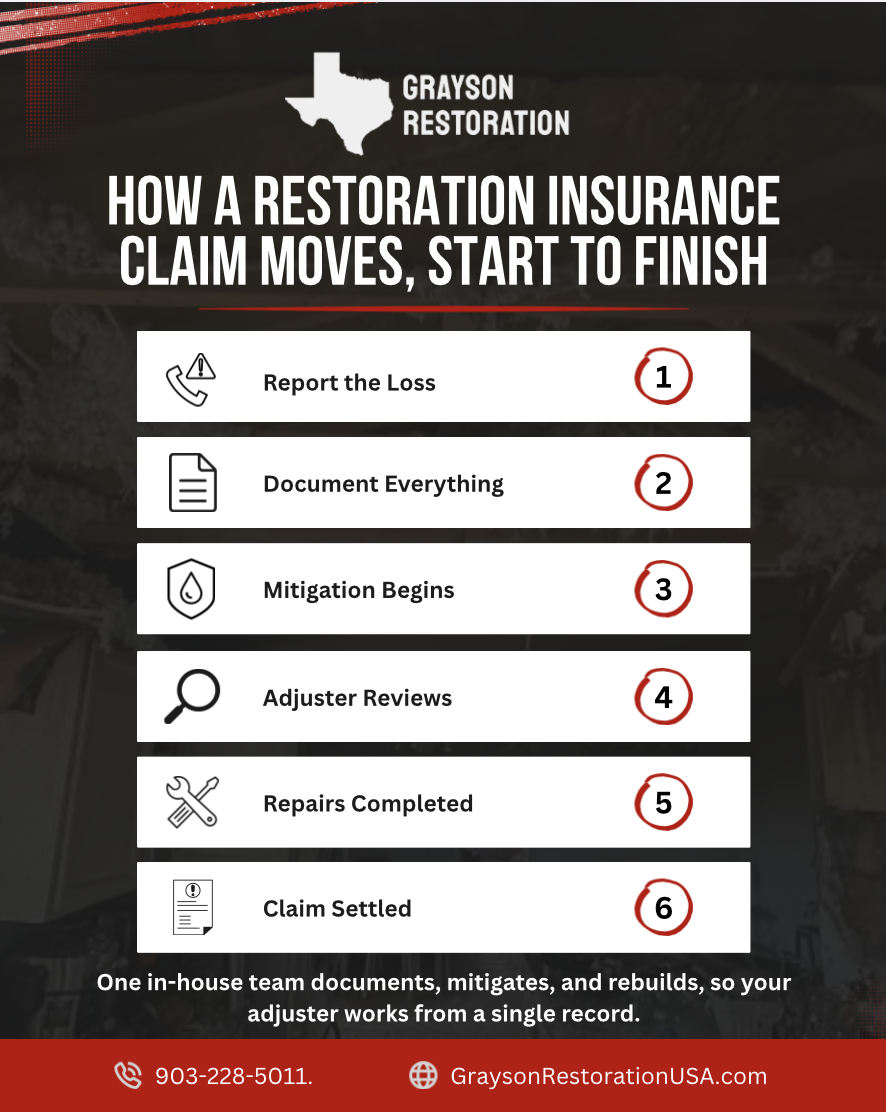
- Report the loss. You contact your insurer and a claim is opened. You do not need every answer to start. You just need to report it promptly, because most policies expect timely notice.
- Document everything. Your early photos and videos become part of the record. This is the step people skip in the rush to clean up, and it is one of the most valuable things you can do.
- Mitigation begins. A restoration team stops the damage from spreading: water extraction and drying, or smoke and soot containment. Acting fast here limits the loss and keeps the claim cleaner.
- The adjuster reviews the damage. Often in person, an adjuster assesses the scope of the loss. Your documentation and your restoration team’s notes support this review.
- The scope is agreed and the work is carried out. The repair and reconstruction scope is settled, then performed. Clear records of what was damaged and what was done keep everything moving.
- The claim is settled. Payment follows the terms of your policy. Good documentation throughout is what keeps this final step straightforward.
That’s the whole arc, from the first phone call to a finished home. It can feel like a lot when you’re standing in it, but each step is manageable on its own, especially when you have a team helping you keep the record straight and translating the parts that sound like a foreign language.
Why Documentation Is What Protects Your Claim
If there is one habit that separates a smooth claim from a stressful one, it is documentation. The photos and videos you take before anything is moved or cleaned are the backbone of the entire process. They establish what was damaged, how far it reached, and what condition things were in before the work began. Memory fades and disputes happen, but a clear visual record settles most questions before they turn into arguments.
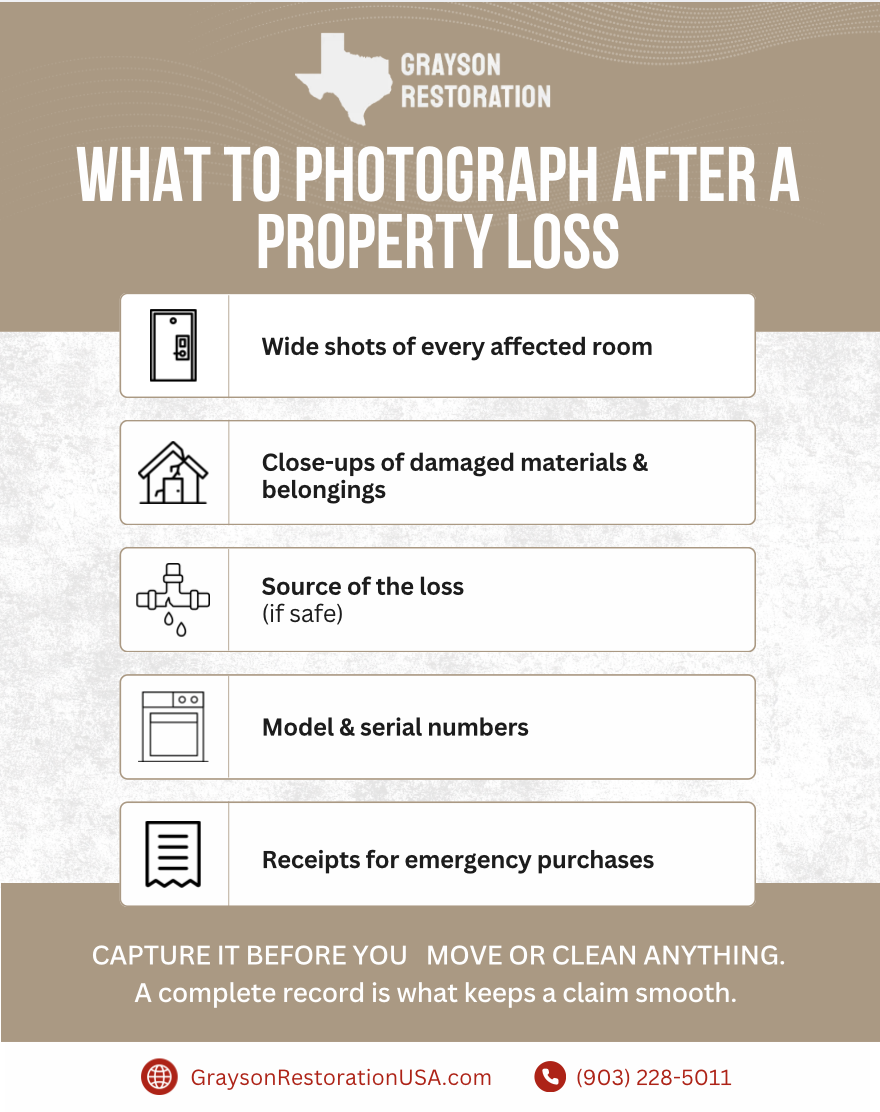
The practical advice is simple. Before you tidy anything, capture wide shots of each affected room and close-ups of soaked or burned materials and belongings. Photograph the source if it is safe to reach, get the serial numbers or model plates on failed appliances, and keep any receipts related to emergency steps you take. Then let the professionals handle the rest, because over-cleaning before documenting can quietly work against you.
This is also where we earn our keep early. We document the damage thoroughly as we work, using moisture meters and detailed notes that show the true reach of a loss, including the hidden moisture a quick glance would miss. That record supports your claim and helps the whole thing reflect the real scope, rather than only what was visible on the surface.
What an Adjuster Does, and How We Work Alongside Them
An insurance adjuster is the person your insurer assigns to review your claim and assess the scope of the loss. They look at the damage, compare it against your policy, and help determine what the claim will cover. Adjusters are not adversaries. They have a job to do, and a well-documented loss makes that job easier and the process faster for everyone.
Here is where our approach helps. Because we handle the mitigation, the documentation, and the rebuild ourselves, we can speak the adjuster’s language and provide the detailed scope, moisture readings, photos, and reconstruction plan they need in one clear package. There is no gap between a dry-out company that left and a rebuild contractor who has not shown up yet. One team holds the whole record, so the adjuster is working from a complete and consistent picture.
To be clear about the line we never cross: we help guide and document the process, but we do not approve claims, set your coverage, or speak for your insurance company. Your coverage is determined by your insurer and your policy. What we can promise is a thorough, organized claim file and clear communication, which is exactly what tends to keep a claim moving instead of stalling.
The In-House Difference: One Team Through the Entire Claim
Most people do not learn how restoration companies are actually structured until they are already in the middle of a project. A national franchise or a marketing-first local shop will often handle the initial dry-out, then hand the demolition, the contents work, or the full rebuild to separate crews. On paper it sounds normal. In practice, every hand-off is a seam where things slip. Schedules fall out of sync between companies, details get lost in translation, and when a timeline slides, no single party owns the problem. You end up coordinating strangers during the worst week of your year.
We built Grayson Restoration to work the opposite way. One accountable in-house team carries your project from the first emergency call through the drying, the claim documentation, the demolition, and the full reconstruction, all the way to the final walk-through. There is one point of contact who knows your home, your claim, and your plan. For the insurance side specifically, that continuity matters more than people expect, because the same team that documented the loss is the team that scopes and completes the repair. Nothing gets dropped between companies, because there is only one company.
Customers tell us the experience feels calmer and more personal than what they expected, and the claim tends to reflect that too. When the record is consistent from first call to final coat of paint, there is far less back and forth and far less chance of something falling through a crack.
Why the Company You Call First Shapes Your Whole Claim
The first company you call after a loss does more than start the drying. They set the tone and the record for the entire claim. If that first team documents carefully, communicates clearly, and can carry the job through the rebuild, your claim starts on solid footing. If they rush the documentation or plan to hand off the hard part later, small gaps can follow you all the way to settlement.
This is why we encourage people not to simply call whoever answers an ad first. A quick phone conversation tells you a lot. Ask whether the company does the work itself or subcontracts the rebuild. Ask how they handle documentation for the claim. Ask whether one point of contact will stay with you the whole way. The answers reveal the kind of week you’re going to have.
Water and fire damage do not keep business hours, so we answer around the clock. Even if all you need in the first moments is someone to talk you through what to do until a crew arrives, that call costs nothing and can save a great deal. You can reach us any time at 903-228-5011.
How Long Does Water Damage Restoration Take?
This is one of the first questions people ask, and a fair one, because everyone wants their home back. The honest answer is that it depends on how much water there was, how far it spread, what materials it soaked into, and the category of the water. A small, contained spill dries quickly. A loss that reached multiple rooms, subfloors, and wall cavities takes longer.
As a general guide, the active drying phase often runs a few days, with professional air movers and dehumidifiers working continuously while a technician monitors moisture and adjusts the setup. The equipment stays until materials reach a verified dry standard, not a moment guessed by feel. Pulling equipment too early is a common way that hidden moisture, and the problems that follow it, sneak back in. You can see how we approach this on our water damage restoration page.
If reconstruction is needed, that is a separate phase with its own timeline. The best thing we can do is assess your specific situation, give you a realistic timeline up front, and keep you updated as the work moves. On the claim side, a realistic timeline also helps set expectations with your adjuster, so no one is surprised when a serious loss takes longer than a minor one. Clear expectations are part of what makes a hard stretch feel manageable, and we would rather tell you the truth than an optimistic guess.
Fire and Reconstruction Run on a Longer Clock
Fire losses and major rebuilds move on a longer timeline than a contained water dry-out, and it helps to know that going in. After the flames are out, there is smoke and soot cleanup, odor treatment, structural assessment, and then the reconstruction itself. Each phase has to be done properly for the next one to hold, which is why rushing a fire job tends to create problems that surface later.
Reconstruction is where a loss becomes a fresh start, and it is the work many mitigation-first companies handle weakly or hand off entirely. Because our roots are in rebuilding, we can take a serious fire loss all the way through, from replacing drywall and flooring to rebuilding cabinetry and trim, matching finishes, and restoring the spaces that make a house feel like home. The same team that documented the fire for your claim is the team putting the home back together, so the scope and the finished work line up.
For a claim, that continuity is quiet insurance against disputes. There is one consistent record of what was damaged, what was agreed, and what was rebuilt, which keeps the settlement conversation grounded in facts everyone can see.
What to Expect When You Call Us
If you have never worked with a restoration company, the unknown can be its own source of stress. Here is what actually happens when you call us, so it feels less like a leap into the dark.
First, you reach a real person, any time of day. We listen, get a sense of what happened, and either talk you through the immediate steps or get a crew moving, depending on the situation. When we arrive, we start with a calm, thorough assessment: what happened, how far it reached, and what the safe next steps are. We document as we go, because that record is the start of your claim file.
From there, we extract water or contain smoke, set professional drying or cleaning in motion, and keep you informed at each stage. The same team documents the damage for your insurance, coordinates with your adjuster, handles any demolition and contents work, and carries out the reconstruction. One point of contact stays with you the whole way, so you always know who to call and what is happening next. There is no sales pressure in any of this. Plenty of first calls are simply people asking whether they should be worried, and we are glad to answer that honestly.
When a Loss Hits a Business, the Claim Has a Deadline
For a commercial property, a water or fire loss carries a cost beyond the repairs: downtime. Every day a dental office, a restaurant, a bar, or a retail space sits closed is a day of lost revenue, missed appointments, and disrupted staff and customers. The claim is not only about restoring the space. It is about getting the business back open, quickly and correctly, while keeping the insurance side airtight.
This is where an in-house, single-team approach earns its place. The hand-offs that slow a home job become genuinely expensive in a business. One team managing the drying, the claim documentation, and the rebuild keeps the timeline tight and the record consistent, which is exactly what a property manager or owner needs when the pressure is on. For commercial restoration, we understand that a partial reopening, careful containment, and clear scheduling can be the difference between a manageable interruption and a costly one.
We work with the kinds of high-end commercial spaces where presentation and timing both matter: dental and medical offices, upscale restaurants and bars, professional offices, and retail. For the manager or owner, having one accountable partner who handles the loss and the claim end to end is what makes a serious event survivable for the business.
Who We Serve, and Why Trust Matters Most Here
Restoration is a trust purchase. No one shops for it in advance, and almost no one enjoys the moment they need it. By the time someone is searching, they are stressed, the stakes are high, and they are deciding fast who to let into their home or business. That’s a lot to ask of a stranger, which is why who we are matters as much as what we do.
We serve affluent homeowners and families across North Texas and nearby Southern Oklahoma, and we serve high-end commercial owners and the property managers, adjusters, plumbers, roofers, and realtors who refer them. What those audiences have in common is that they value quality, clear communication, and accountability over the cheapest or fastest option. They want to feel like they are in good hands, and they want proof of that before they call.
Our proof is 17 years of work in these communities, a team whose names show up in our reviews, and a track record we are glad to stand behind. When your name is on every job you do in your own backyard, you have every reason to get it right and to be there the next time a neighbor needs help. That’s the kind of trust a national franchise cannot pack up and take with it.
What Our Neighbors Say
We would rather let our customers describe the experience than describe it ourselves. Our Google rating currently sits at 5.0 stars across 120+ reviews, and the reviews say more about the day-to-day than any marketing line could.
Kaitlyn H. wrote about an outstanding experience after water damage, from the first call to the finished work. She noted that we treated the situation with urgency and had someone at her door within a couple of hours, that Chelsea made the process calm and stress-free, and that Mark and JC were professional on site, took the time to explain everything, and left the family feeling confident they were in good hands. Tim T. kept it short and warm: Trevor and his crew fixed up their son’s room perfectly after a nasty water leak, and it looks brand new again.
Those are real people in our service area describing the exact things this whole guide is about: fast response, clear communication, careful work, and a team that stays with you. If you would like to read more of them, they are on our Google profile, and we are grateful for every one.
Common Claim Mistakes to Avoid
A few avoidable missteps cause most of the claim headaches we see. Knowing them ahead of time keeps your options open.
- Cleaning up before documenting. It is natural to want to tidy, but moving or tossing items before you photograph them can complicate the claim. Capture everything first.
- Waiting to report the loss. Most policies expect timely notice. Reporting promptly, even before you have every detail, keeps the claim on solid ground.
- Throwing away damaged items too soon. Damaged belongings are often part of the claim. Photograph and set them aside rather than hauling them off before they are documented.
- Assuming surface-dry means dry. Materials can feel dry while moisture hides behind them. Only proper measurement confirms it, and undocumented hidden moisture can undercut a claim later.
- Guessing at your own coverage. It is tempting to decide in advance what is or is not covered and act on that guess. Let the claim process and your adjuster answer it, and keep the record complete in the meantime.
None of these are fatal, and we can usually work with whatever state things are in on arrival. Avoiding them simply gives you a head start, and a head start is exactly what you want in the first day of a loss.
After the Claim: Getting Back to Better Than Before
A claim is not the finish line. The finish line is a home or business that feels whole again. That’s why we care about the rebuild as much as the paperwork. Once the scope is agreed, our team carries the reconstruction through to a finished, move-in-ready result, matching finishes and restoring the details that make a space yours.
This is also where the in-house model quietly pays off one more time. Because the crew that dried or cleaned the property is the crew rebuilding it, the knowledge carries forward. They already know what happened, what was affected, and what the finish needs to be. Nothing has to be re-explained to a new contractor halfway through. That continuity is how a loss turns into a fresh start rather than a months-long ordeal of chasing separate companies.
If any mold-related concerns come up during the process, our team can provide the support those situations call for, including proper containment and controlled drying so the problem does not spread. The goal from first call to final walk-through is the same: back to better than before, handled by people you can reach by name.
Serving North Texas and Southern Oklahoma
We are based in Gunter, Texas, and we serve North Texas and nearby Southern Oklahoma, including Sherman, Denison, Durant, Kingston, and the surrounding communities. That corridor is often underserved by the larger restoration companies focused on the DFW core, which means a local team can frequently reach you faster when minutes matter. For fire restoration, we travel statewide across Texas.
Being local runs deeper than a quick drive. It is reputation. We have worked in these communities since 2008, and our name is on every job we do here. Wherever you’re in our service area, the promise is the same: one experienced, in-house team that treats your property with care, documents your claim thoroughly, and stays accountable from the first call to the final walk-through.
