


If you have water damage, start by staying safe and stopping the source. Shut off the water if you can, avoid standing water near outlets or appliances, and only handle what’s safe to handle. Take photos and video of everything before you move it, since that record helps with your insurance claim. Move what you can to a dry area, and call a professional restoration team to begin drying before hidden moisture causes more damage. Grayson Restoration USA is based in Gunter, TX, serves North Texas and Southern Oklahoma, and is available 24/7 at 903-228-5011. We handle the cleanup, the claim, and the rebuild with one in-house team, so you’re never passed around.
Water damage rarely arrives at a convenient time. A pipe lets go overnight. A water heater fails while you’re at work. A storm pushes water in under a door, or an upstairs supply line drips for days before anyone notices the stain on the ceiling. However it starts, the feeling is usually the same: a quiet kind of panic, and a long list of questions you’ve never had to answer before.
If that’s where you’re right now, take a breath. The first hours matter, but you don’t have to figure all of this out alone, and you don’t have to make it perfect. This guide walks through exactly what to do in the first 24 hours after water damage, in plain language, so you can protect your home and your family, keep your options open with insurance, and get the right help on the way. We’ll also explain how the restoration process actually works, what hidden moisture can do if it isn’t handled, and what to look for in a company you can trust with your home.
We’re Grayson Restoration USA, a residential and commercial restoration and reconstruction team based in Gunter, Texas. We’ve served North Texas since 2008, more than 17 years, and we cover North Texas and nearby Southern Oklahoma, including Durant, Kingston, and surrounding communities. What sets us apart is simple: we keep one accountable team on your project from the first call to the final walk-through, including the insurance claim and the full rebuild. No hand-offs, no finger-pointing, no waiting on a subcontractor someone else hired. If you’d rather talk to a person right now, we’re here 24/7 at 903-228-5011.
Water Damage Doesn’t Wait, and Neither Should You
Water is patient and relentless. In the first few minutes it spreads across the floor and soaks into whatever it touches. Within an hour or two it’s wicking up into baseboards and drywall, settling into the pad under your carpet, and finding its way into the cavities you can’t see. By the next morning, what looked like a contained spill has quietly traveled farther than you’d guess, and the longer it sits, the more it costs to put right.
That’s not meant to frighten you. It’s meant to explain why moving with calm purpose in the first 24 hours makes such a difference. Acting early tends to mean less damage, a smoother insurance claim, and a faster return to normal. Waiting tends to mean the opposite. The good news is that the early steps are simple, and a professional team can take the weight off your shoulders quickly once you make the call.
So think of the first day in two parts. First, the things only you can do right now to keep everyone safe and limit the spread. Second, getting a qualified restoration team on the way so the drying starts before moisture has time to do its quiet work. We’ll cover both.
The First Hour: Stay Safe, Then Stop the Source
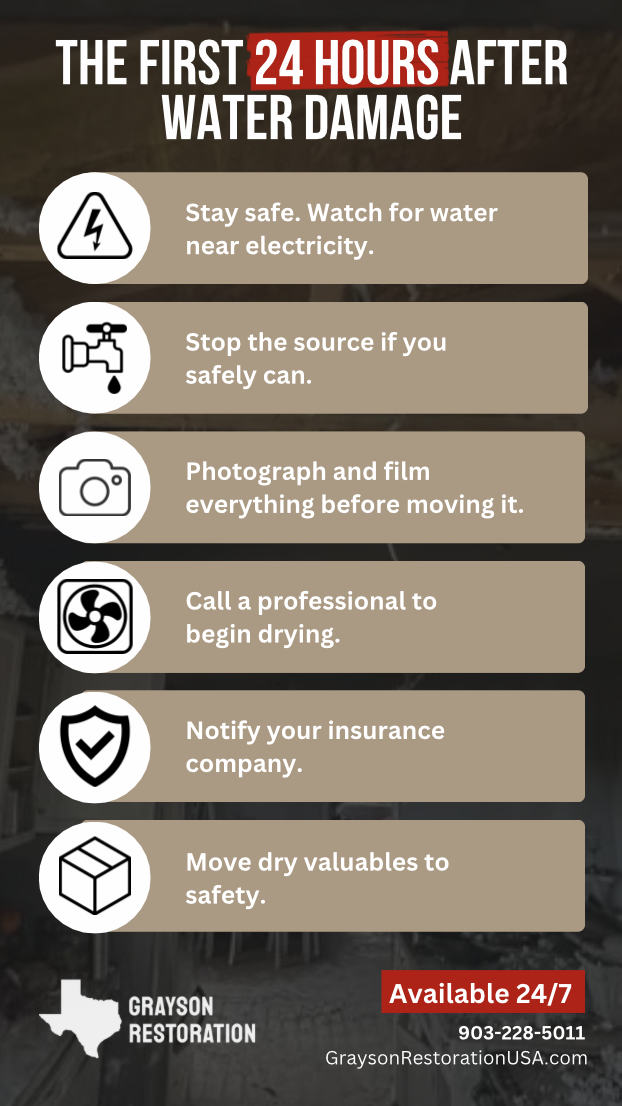
Before anything else, make sure the situation is safe. Water and electricity are a dangerous combination, so if there’s standing water near outlets, appliances, or your electrical panel, stay out of it and don’t wade in to investigate. If you can reach your breaker box safely and without stepping into water, shutting off power to the affected area is a smart move. If you’re unsure, leave it alone and let a professional handle it.
Next, stop the water at its source if you can do so safely. For a burst pipe, a failed water heater, or an overflowing fixture, that usually means turning off the main water supply to the home. It’s worth knowing where your main shutoff valve is before you ever need it, because finding it under pressure is a lot harder. If the water is coming from a storm, a roof leak, or rising water outside, there may be no source to shut off, and your focus shifts to safety and limiting how far the water travels indoors.
A few more first-hour basics, only if they’re safe to do: lift draperies off wet floors, move small valuables and electronics to a dry room, and place foil or wood blocks under furniture legs to slow staining. Don’t use a household vacuum to remove water, and don’t start tearing into walls. The aim in the first hour isn’t to fix anything. It’s to stay safe, stop the flow, and protect what you easily can.
If the source is hidden, a slow leak behind a wall or under a slab that you can hear or smell but can’t find, that’s a job for professional water leak detection, which locates the problem without tearing your home apart to find it.
The First 24 Hours, Step by Step
Once everyone’s safe and the water’s stopped, the rest of the first day is about documentation, limiting damage, and getting professional drying underway. Here’s a calm, practical order to work in.
- Document everything first. Before you move or clean anything, take clear photos and video of all the damage, from wide shots of each room to close-ups of soaked materials and belongings. This record is one of the most useful things you can do for your insurance claim, so don’t skip it in the rush to clean up.
- Call your restoration team. The sooner drying begins, the less damage water can do. A professional team brings extraction equipment, commercial air movers, and dehumidifiers that pull moisture out of materials your towels never could. This is the step that most affects how the whole thing turns out.
- Notify your insurance company. Report the loss to your insurer so the claim can get started. You don’t have to have every answer. A good restoration partner can help you document the damage and walk alongside you through the process.
- Move what you safely can. Relocate dry belongings away from the affected area, and set wet items somewhere they can begin to air out. Leave anything heavy, hazardous, or questionable for the professionals.
- Resist the urge to over-clean. It’s natural to want to scrub everything back to normal, but improper cleanup can spread contamination or hide moisture that needs to come out. Stabilize the scene, then let the pros assess it.
That’s the whole first day in a nutshell: safe, dry, documented, and supported. Everything after that, the detailed drying, the claim, and any rebuild, is where a restoration team earns its keep.
Why Hidden Moisture Is the Real Problem
The water you can see is rarely the whole story. The part that causes the most trouble is the moisture that disappears into places you can’t easily reach: inside wall cavities, under flooring, beneath cabinets, in the subfloor, and up into insulation. Surfaces can feel dry to the touch while the materials behind them stay wet for days.
That trapped moisture is what leads to the secondary problems people don’t expect: warped floors, swollen trim, peeling paint, lingering odors, and the conditions that allow mold to develop. Mold needs only moisture and time, and in our North Texas humidity it doesn’t need much of either. This is exactly why professional drying matters. A restoration team uses moisture meters and thermal imaging to find water you can’t see, then dries those materials to a verified standard rather than guessing.
It’s also why a quick mop-up, while it feels productive, often isn’t enough on its own. The visible water comes up easily. The hidden water is what determines whether your home is truly dry or just dry on the surface. Getting that part right is the difference between a clean recovery and a problem that resurfaces weeks later.
Water Leak Detection With Thermal Cameras
Not every water leak is easy to see. A pipe can drip behind drywall, moisture can spread under flooring, and a hidden leak can sit inside a wall cavity long before a stain appears. That is why professional water leak detection matters. Grayson Restoration uses thermal cameras, moisture meters, and professional water damage inspection tools to help locate hidden moisture without unnecessary demolition.
Thermal imaging helps our team find temperature differences that may point to water behind walls, under floors, around ceilings, near cabinets, and inside other hard-to-see areas. From there, we can confirm the moisture, identify how far the water has traveled, and build a clear plan for water damage cleanup, structural drying, and restoration.
If you suspect a hidden water leak, slab leak, pipe leak, ceiling leak, wall leak, or moisture problem in your home or business, do not wait for the damage to spread. Early leak detection can help prevent warped floors, swollen drywall, musty odors, mold concerns, and more expensive repairs later. Grayson Restoration provides water leak detection, water damage restoration, moisture detection, thermal imaging inspections, water mitigation, and reconstruction for homes and businesses across North Texas and Southern Oklahoma.
The Three Categories of Water, and Why They Change Everything
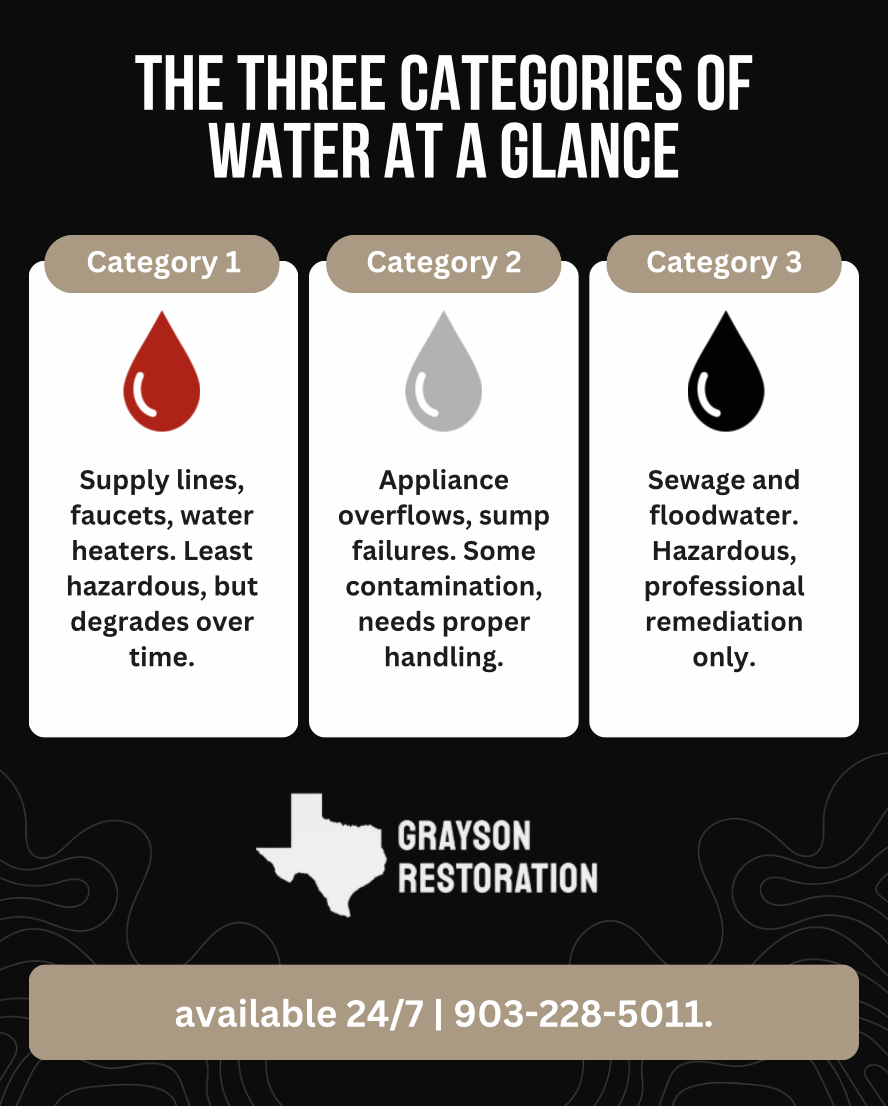
Not all water damage is equal, and the source of the water shapes how it has to be handled. The restoration industry sorts water into three categories, and knowing the difference helps you understand why professionals approach each one differently.
Category 1: Clean water
This is water from a sanitary source, like a supply line, a faucet, or a water heater. It’s the least hazardous, but it doesn’t stay clean for long. Left sitting, clean water picks up contaminants from materials and surfaces and can degrade into a more serious category within a day or two, which is one more reason early drying matters.
Category 2: Gray water
Gray water carries some contamination, from sources like a dishwasher or washing machine overflow or a sump pump failure. It can cause illness if ignored and needs proper handling, protective equipment, and thorough cleaning, not drying alone.
Category 3: Black water
This is the most hazardous category, including sewage backups and floodwater from outside. It carries bacteria and other health risks and requires careful, professional remediation. This is never a do-it-yourself situation.
You don’t need to diagnose the category yourself. You just need to know that the source matters, that water can move from one category to the next as it sits, and that a professional team will assess it and handle each one to the right standard, including the safety steps a homeowner shouldn’t take on alone.
How the Insurance Claim Actually Works
For a lot of homeowners, the insurance claim is the most stressful part, more than the water itself. It doesn’t have to be. While every policy and every claim is different, the general path tends to follow the same shape, and understanding it takes away a lot of the worry.
It usually starts when you report the loss to your insurer and a claim is opened. Your documentation, those early photos and videos, becomes part of the record. An adjuster reviews the damage, often in person, to assess the scope. From there, the restoration work is scoped, agreed, and carried out, and the claim is settled according to the terms of your policy. Throughout, clear documentation of what was damaged and what was done keeps everything moving.
Here’s where a restoration partner makes a real difference. A good team helps you document the damage thoroughly, communicates clearly about the scope of work, and supports you through the process so you’re not navigating it alone. To be clear about what that means: we help guide and document the process, but we don’t approve claims, set coverage, or speak for your insurance company. Your coverage is determined by your insurer and your policy. What we can promise is that we’ll help make the process more organized and a lot less overwhelming.
Does Insurance Cover Water Damage?
It depends, and the honest answer is that it comes down to your specific policy and the cause of the damage. As a general rule, many homeowners policies cover water damage that’s sudden and accidental, like a pipe that bursts without warning. Damage that results from long-term neglect or a lack of maintenance is often treated differently. Flooding from outside is typically handled under separate flood coverage rather than a standard homeowners policy.
Because the details vary so much, the most reliable answers come from your own policy and your insurance company. We’d never want to tell you that something is or isn’t covered, because that’s your insurer’s call, not ours. What we can do is help you document the damage clearly and thoroughly from the start, which tends to make the entire claim smoother no matter how it’s resolved in the end. When you’re in the first hours of a loss, the best move is simple: document everything, report the claim, and let a restoration partner help you organize the rest.
The In-House Difference: One Team From First Call to Final Walk-Through
Here’s something most people don’t learn until they’re in the middle of a restoration: many companies don’t actually do all the work themselves. A national franchise or a marketing-heavy local shop will often handle the initial dry-out, then subcontract the demolition, the contents cleaning, or the rebuild to other crews. That’s where the trouble starts. Schedules slip between companies. Nobody owns the whole picture. And when something falls through a crack, you’re the one chasing it down.
We built Grayson Restoration to work the opposite way. One accountable in-house team handles your project from the first emergency call through the drying, the claim documentation, the demolition, and the full reconstruction, all the way to the final walk-through. There’s one point of contact who knows your home and your claim. There are no hand-offs to strangers and no finger-pointing when timelines are on the line. For a homeowner in a stressful moment, that single thread of accountability is the thing that actually lowers the stress.
It’s also why our customers describe the experience as more personal and smoother than what they expected. When the same team that dried your home is the team rebuilding it, the details don’t get lost in translation. That continuity is the heart of what we do, and it’s the part of restoration that’s hardest to find and easiest to feel.
Reconstruction: Getting Your Home Back to Better Than Before
Drying out a home is only half the job. The other half is putting it back together, and that’s where a lot of restoration companies come up short. Our roots are in reconstruction, the rebuild phase that takes a property from damaged to whole again, and often better than it was before the loss.
Reconstruction is the work most mitigation-first companies handle weakly or hand off entirely: replacing drywall and flooring, rebuilding cabinetry and trim, matching finishes, repainting, and restoring the spaces that make a house feel like home. Because we carry real reconstruction depth, we can take a serious loss all the way through, a full kitchen rebuild after a burst supply line, or a whole-home recovery after a major event, without bringing in a separate contractor partway through.
For you, that means the team that understands exactly what happened to your home is the same team restoring it. The drying decisions, the claim documentation, and the rebuild all connect, because one company is holding all of it. That’s how a loss becomes a fresh start instead of a months-long ordeal.
What to Look For in a Restoration Company
When you’re choosing who to trust with your home, a few things separate a company you’ll be glad you called from one you’ll regret. Here’s what actually matters, so you can decide with confidence even under pressure.
- In-house capability. Ask whether the company does the work itself or subcontracts the rebuild. One accountable team from start to finish means fewer hand-offs and less stress.
- Leak detection. We restore homes and businesses after water, fire, storm, and related damage, using leak detection to help find hidden moisture and one in-house team to handle your project from the first call to the final walk-through, including the insurance claim and the full rebuild.
- Real reconstruction experience. Drying is the easy part. The ability to rebuild and finish the work to a high standard is what gets your home truly back to normal.
- Clear, honest communication. You want a team that explains what’s happening in plain language and keeps you informed, especially around the insurance process.
- Genuine experience and reputation. Tenure and a clean track record matter in an emergency. Years of real work are something newer, marketing-first companies can’t manufacture.
- Availability when it counts. Water damage doesn’t keep business hours. A team that answers around the clock is a team that can start protecting your home sooner.
If you hold any company up to that list, you’ll quickly see the difference between a true restoration partner and a dispatcher who sends whoever’s available. The right partner makes a hard week feel manageable.
Water Damage in a Business Runs on a Different Clock
For a commercial property, water damage carries a cost beyond the repairs: downtime. Every day a dental office, a restaurant, a bar, or a retail space sits closed is a day of lost revenue, missed appointments, and disrupted staff and customers. The priority isn’t only restoring the space. It’s getting the business back open, quickly and correctly.
That’s where an in-house, single-team approach is especially valuable. For commercial restoration, the hand-offs that slow a residential job become genuinely expensive in a business. One team managing the drying, the claim, and the rebuild together keeps the timeline tight and the communication clear, which is exactly what a property manager or owner needs when the pressure is on.
We work with the kinds of high-end commercial spaces where presentation and timing both matter: dental and medical offices, upscale restaurants and bars, professional offices, and retail. We understand that a partial reopening, careful containment, and clear scheduling can be the difference between a manageable interruption and a costly one. For property managers and business owners, having one accountable partner who handles the loss end to end is what makes a serious event survivable for the business.
When to Call a Professional
Some small spills you can handle with towels and a fan. But there are clear signs it’s time to bring in a professional, and calling sooner rather than later almost always works in your favor. Reach out if the water covers a large area, if it has soaked into walls, flooring, or cabinetry, if it came from anything other than a clean source, if you smell mustiness or see any discoloration, or if you simply aren’t sure how far it has spread. When in doubt, a quick phone call costs nothing and can save a great deal.
Because water damage doesn’t wait for morning, we’re available 24/7 by call or text. If something has happened at your home or business right now, you can reach us at 903-228-5011 and we’ll help you figure out the next step, even if it’s just talking you through what to do until we arrive.
How Grayson Restoration Handles Water Damage in North Texas and Southern Oklahoma
When you call us for water damage restoration, here’s what working with us looks like. We respond quickly, around the clock, and start with a calm, thorough assessment of what happened and how far it has reached. We extract standing water, set professional drying equipment, and monitor moisture until the affected materials reach a verified dry standard, well beyond what feels dry to the touch.
From there, the same team documents the damage to support your insurance claim, handles any demolition and contents work, and carries out the full reconstruction to put your home or business back together. One point of contact stays with you the entire way, so you always know who to call and what’s happening next. It’s a calmer, more personal experience than being passed between companies, and it’s how we’ve worked since 2008.
We’re based in Gunter, Texas, and we serve North Texas and nearby Southern Oklahoma, including Durant, Kingston, and the surrounding communities, an area that’s often underserved by the larger restoration companies focused on the DFW core. For fire restoration, we travel statewide. Wherever you’re in our service area, the promise is the same: one experienced, in-house team that treats your property with care and stays accountable from the first call to the final walk-through.
Common Causes of Water Damage, and the Ones We See Most
Water damage rarely announces itself. It tends to come from ordinary parts of a home doing something unexpected, often at the worst possible time. Knowing the usual sources helps you spot trouble early and understand where to look when something feels off.
Burst and frozen pipes are near the top of the list, especially during a North Texas cold snap. When temperatures drop and a pipe freezes, the pressure can split it, and the water arrives the moment things thaw. Water heaters are another common culprit. They tend to fail gradually, then all at once, sending dozens of gallons across a floor. Appliances cause their share too: dishwashers, washing machines, refrigerator ice-maker lines, and the supply hoses behind them all fail quietly and sometimes run for hours before anyone notices.
Then there’s water that comes from outside or from above. Roof and storm leaks show up after wind and hail, often as a stain that spreads across a ceiling. And one of the trickiest sources is the slab leak, a pipe failing beneath a concrete foundation, which can go undetected for a long time. These hidden leaks are exactly where professional water leak detection earns its place, finding the problem precisely instead of opening walls to hunt for it.
In our part of Texas, shifting clay soils, hot summers, and hard winter freezes all add stress to a home’s plumbing and roof over time. None of this means you should worry about your house. It just means that when water does appear, acting quickly and knowing where it likely came from makes the whole recovery faster and calmer.
Common Mistakes to Avoid After Water Damage
In the rush of a water emergency, good intentions can sometimes make things harder. A few common missteps are worth knowing so you can sidestep them and keep your options open.
- Waiting to call for help. Time is the single biggest factor in how a water loss turns out. The longer materials stay wet, the more damage spreads, so an early call almost always works in your favor.
- Cleaning up before documenting. It’s natural to want to tidy, but moving or tossing items before you photograph them can complicate your insurance claim. Capture everything first.
- Using a household vacuum on water. Standard vacuums aren’t built to extract water and can create a safety hazard. Leave extraction to professional equipment.
- Assuming surface-dry means dry. Floors and walls can feel dry while the materials behind them stay wet for days. Only proper measurement confirms a space is truly dry.
- Handling contaminated water yourself. If the water came from a sewage backup or outside flooding, it carries real health risks. That’s a job for trained professionals with the right protection.
None of these mistakes is the end of the world, and a good restoration team can usually work with whatever state things are in when they arrive. But avoiding them gives you a head start, and a head start is exactly what you want in the first day.
Mold, and Why the Clock Matters
Of all the reasons to dry a home quickly, mold is the one people ask about most. Here’s the honest picture, without the scare tactics. Mold isn’t a mystery and it isn’t a guarantee. It’s biology. It needs moisture and time, and when those two things are present together, it can begin to develop within a day or two. In our North Texas humidity, the conditions are often favorable, which is exactly why fast, thorough drying matters so much.
The good news is that the same early steps that limit water damage also limit the chance of mold. When professional drying removes moisture from materials quickly and to a verified standard, you take away the conditions mold needs. That’s a far better position than letting things dry on their own and hoping. If mold-related concerns do come up, our team can provide the support those situations call for, including proper containment and controlled drying so the problem doesn’t spread.
One practical note: if you ever see or smell something that makes you suspect mold, don’t disturb it. Disturbing a suspected area can spread spores into the air and around the home. The better move is to leave it alone, keep the area ventilated if you safely can, and let a professional assess it. As with everything else in restoration, the calm, measured response beats the frantic one every time.
How Long Does It Take to Dry Out a Home?
It’s one of the first questions people ask, and a fair one, because everyone wants their home back to normal. The honest answer is that it depends on a few things: how much water there was, how far it spread, what materials it soaked into, and the category of the water. Drying a small, contained area is quick. Drying a home where water reached multiple rooms, subfloors, and wall cavities takes longer.
As a general guide, the active drying phase often runs a few days, with professional air movers and dehumidifiers working continuously while a technician monitors moisture levels and adjusts the setup. The equipment stays until the materials reach a verified dry standard, not a moment guessed by feel. Pulling equipment too early is a common way that hidden moisture, and the problems that follow it, sneak back in.
If reconstruction is needed, that’s a separate phase with its own timeline, depending on the scope of the rebuild. The best thing we can do is assess your specific situation, give you a realistic timeline up front, and keep you updated as the work moves along. Clear expectations are part of what makes a hard week feel manageable, and we’d rather tell you the truth than an optimistic guess.
Storms, Freezes, and the Seasons That Bring Water Damage
Water damage has a seasonal rhythm in North Texas. Spring and early summer bring storm season: hail, high winds, and heavy rain that find their way through roofs and around windows. Storm damage repair often starts with water that came in during the storm and the hidden moisture it left behind.
Winter brings a different and often bigger wave. A hard freeze can burst pipes throughout a home, and because the water arrives when things thaw, the damage can appear suddenly and spread fast. Add holiday cooking and space heaters to the mix, and the colder months are genuinely the season we stay busiest. If you take one preventive step before winter, make it this: know where your main shutoff is, keep your home heated during a freeze, and let faucets drip on the coldest nights.
Whatever the season, the constant is that we’re ready for it. We’re available 24/7, year-round, across North Texas and Southern Oklahoma, with statewide reach for fire restoration. Whether it’s a summer storm or a January freeze, the right response is the same: stay safe, document the damage, and call a team that can take it from there.
Water Mitigation vs. Water Restoration: What’s the Difference?
People hear both terms and assume they mean the same thing. They’re related, but they’re not identical, and knowing the difference helps you understand what actually has to happen to your home after a loss.
Water mitigation is the urgent first phase, the work that stops the damage from getting worse. It’s the water extraction, the removal of materials that can’t be saved, and the professional structural drying that brings moisture levels back down. Mitigation is about speed and limiting the loss while the clock is still running.
Water restoration is what comes after: returning your property to the way it was, or better. That’s where the repairs, the replacement, and the full reconstruction come in, from new drywall and flooring to finished, move-in-ready spaces. It’s the difference between a house that’s merely dry and a home that’s whole again.
Here’s where most companies fall short: they do one part well and hand off the other. We handle both, the mitigation and the restoration, with the same in-house team. The people who dried your home are the people who rebuild it, which means nothing gets lost between crews. For you, that’s one phone number, one point of contact, and one team accountable for the entire job from the first hour to the final coat of paint.
Why a Local North Texas Restoration Company Makes a Difference
When you search for water damage restoration near me, you’re looking for more than the first name in the results. You want a team that can actually reach you quickly, that knows the area, and that’ll still be here next year if you ever need them again. A local company answers all three.
We’re based in Gunter, and we serve North Texas and nearby Southern Oklahoma, including Durant, Kingston, Sherman, Denison, and the surrounding communities. That corridor is often underserved by the larger restoration companies focused on the DFW core, which means a local team can frequently get to you faster when minutes matter most. In an emergency, proximity isn’t a small thing. It’s the head start that limits the damage.
Being local runs deeper than a quick drive, though. It’s reputation. We’ve worked in these communities since 2008, and our name is on every job we do here. That accountability shows up in how we treat your home and how we stand behind the work. A national franchise can pack up and move on to the next market. A local company that’s spent more than 17 years earning trust in North Texas has every reason to get it right, and to be there the next time a neighbor needs help.
Getting Help and What Happens Next
If you’re dealing with water damage right now, you’ve already done the hardest part by looking for the right way forward. Take the early steps you safely can, keep a record of everything, and reach out so a professional team can take it from there. You don’t have to manage this alone, and you don’t have to navigate the insurance process by yourself either.
When you’re ready, we’re here. One in-house team, more than 17 years of experience, and a calm, accountable approach from the first call to the final walk-through. You can reach out through our contact page or call us any time.
